Monday, August 13, 2012

25 and Going on Menopause


In this past season of the Bachelorette, Emily asks one of her dates, Ryan, if he would still love her in 10 years if she got fat. Ryan famously answers, “I’d love ya, but I wouldn’t love on ya.” I never liked Ryan, but appreciated his honesty. My friend was not offended by Ryan’s comment, “Imagine you marry someone who has a good job and works hard, and once you get married, he quits his job, sits on the couch all day, and collects unemployment. Would you feel lied to?”

“I would be able to sense his poor work ethic and I wouldn't be attracted to him in the first place, so that would never happen to me, but I guess I understand your analogy,” I told him.

I work with a lot of women who struggle with weight gain, and a lot of these women attribute it to age and a slowing metabolism. I’ve heard variations of this story several times, “I weighed 120 lbs when I got married, and now I weigh 180.”

This use to make me worried, because I almost felt as if weight gain was inevitable, but the more I talk to women, the more I realize, it is not inevitable. While counseling these women on developing healthy lifestyles, I continuously make mental notes of where I think they’ve gone wrong. I’ve compiled a list:

1. Develop good eating habits now. When I was in high school I worked at Cold Stone and ate ice cream every day, I would go to In-n-Out and get a grilled cheese sandwich with extra sauce and French fries, and I never exercised; I was 95 lbs. I could still do this now if I didn’t mind looking like Jabba the Hut and having a heart attack at 45. If you eat poorly, you will get fat… it’s all about portion sizes and healthy choices, everyday.

2. Don't stop exercising. Use it or lose it. Muscle tone and regular cardio will keep your metabolism going. Everyone’s excuse is that there is “no time.” Make time. Time management is a struggle for everyone, but it’s doable. The longer you're sedentary, the harder it is to start exercising again... But it's never too late to start :)

3. Don’t wear pants with elastic. I’m serious. Have you been in a hospital lately? I am convinced that if hospital workers had to wear jeans to work, their weight would drop by at least 10%. If your job requires you to wear scrubs, when you go home, put on a pair of jeans. It’s really easy to gain weight when you wear one size fits all clothes 24/7. This includes leggings. It’s a slippery slope. Be careful. Wearing dresses everyday is pretty risky too.

4. Make time to relax. Chronic stress is the new plague. Find anything enjoyable that allows you to figure out your s appropriately. Talk it out, hug it out, write it out, or whatever it takes to manage whatever problems you have.

5. Have hobbies; hobbies that don’t involve food. Everyone should do something that makes them unique, happy, and accomplished. Being a mom is great, but it doesn’t count as a hobby.

6. Learn good coping mechanisms. People are taught a lot of things, coping mechanisms aren’t one of them. I see a lot of people who eat because they’re depressed, stressed, or anxious. If you don’t know what good coping mechanisms are, buy a book on coping skills.

7. Get some positive thinking skills—hormonal changes never results in rational thinking. Don’t let yourself get depressed. Happiness is a choice. Laugh and smile. No one likes a scowl, and there are always things to laugh about. Life is great.


So I’m turning 25 this year and I have nothing to worry about :)

Tuesday, April 10, 2012

Things Change.

I’ve never understood why people are so disgusted by meat. I’ve been on several dates where the guy has asked my permission to order meat. I appreciate their thoughtfulness, but I also think it’s such a silly question. Why would I care if they ate meat?

My siblings and I were the only vegetarians in our entire extended family, so I’ve grown up around meat and meat eaters. I have always thought that people who think meat is “gross” are closed-minded and sheltered. My point is that I don't care, and never have cared, if people choose to eat meat.

About a year ago I started eating fish. I started eating fish because I loved the flavor. My roommate/classmate/friend told me, “Fish is a gateway meat; it’s only a matter of time before you start eating chicken..turkey… then who knows.” I laughed and thought it was probably true, and it was.

Within the past month, I started lifting weights, and I wanted to increase my protein intake, so I calculated that each of my meals should be at about 20 grams of protein. I eat at the hospital a lot and they serve chicken a lot, so I started having chicken at lunch. I’d rather eat chicken than drink a protein shake, I told myself. Who knows what’s in a protein shake? Where are they getting the protein? It’s so processed. Protein shakes are not natural and we were not meant to eat protein like that.

So there I am at the hospital… Hmmm… what to eat, they aren’t serving anything good today. I’ll just have this chicken pesto wrap. That sounds good, 380 calories and 26 grams of protein. As I’m eating my sandwich these are my following thoughts:

Hm. This is not a whole wheat wrap, that’s unfortunate; I wish this was a whole wheat wrap…

This lettuce is a little wilted… I wonder how long this sandwich was made…

Sheesh this is a lot of chicken… I tell my patients to eat 3 oz of meat per meal or the size of the palm of their hand… this chicken is like 2 palms of my hand. Eh, just finish the sandwich you need the protein to build muscle….

I’ve never eaten this much chicken in my entire life. I don’t want to eat this anymore…

Why did I eat this? How does meat get digested? When you eat whole grains, vegetables, fruits, nuts, and beans the fiber helps the food get digested and moves it through your body… What is moving this chicken through my body? Nothing. NOTHING is moving this chicken through my body. This wasn’t even a whole wheat wrap! And that lettuce hand like 1 gram of fiber! How will this chicken ever get out of my body!? I HAVE A ROTTING CHICKEN CARCASS STUCK IN MY BODY.

Since this incident, I have not touched meat. And the thought of eating meat is nauseating. Right now, when I was talking about “liking fish,” it made me shutter with disgust. Because now when I think of eating meat, all I can think about is having a dead animal in my body. I don’t want any dead animals in my body.

I’ve always said that being vegan is most likely the most optimal diet. I’m not vegan. I eat cheese and Greek yogurt. I think the most important thing is having plant based diet. Meaning you eat mostly plants: brown rice, barley, beans, lentils, fruits, vegetables, split peas, almonds, walnuts, and other nuts. If some dairy or eggs get in there, fine, a little dairy and eggs won’t kill you (although some will argue that point). If you want to add some meat in there, that’s fine too. Just make sure it’s organic or from a trusted farm and eat high fiber foods with it. No one likes a rotting carcass in their intestines.

Maybe my thought process is irrational, but at this time, I can’t get that picture of meat carcass out of my head. Being a vegetarian has so many health benefits, decrease in cancer, decrease in heart disease, and overall longevity. Being vegetarian also has a lot of non-health related benefits: better for the environment, less production of meat, and less animal cruelty – yes that really does happen.

Here’s an article my friend posted on chicken and what they do to it… and if they’re doing it to chicken, you know they’re doing it to other animals too.

http://www.nytimes.com/2012/04/05/opinion/kristof-arsenic-in-our-chicken.html?_r=1&src=tp&smid=fb-share

Monday, February 27, 2012

Bucket List

I am not known for my love of the outdoors. I appreciate nature and the comfort of the indoors. However, I will never forget my first time in Bass Pro Shop. I was just hanging out with my dad one afternoon and he suggested we go there. That store is like an amusement park for mountain men. I was impressed. I was probably equally excited about that store as I would be in Nordstrom during their anniversary sale. Weird, I know, but there are so many cool gadgets and little useful tools. Who knew so much thought went into outdoor activities. It made me feel like I could survive a week long camping trip, in a tent. Anyway, this store became particularly useful to me when I realized something on my bucket list was to physically catch, gut, scale, cook, and eat a fish. After reading the Omnivore’s Dilemma, I realized that if you choose to eat meat, you should experience what it really means to eat meat. Meat is not just food. It is an animal that was once alive, living, just chilling, until it was killed, so that you could eat it.

The key concept here is that YOU didn’t have to kill it. You just BOUGHT it in a grocery store; lifeless, guilt-free, packaged, ready for you to cook up and eat. It’s not the same as buying a loaf of bread or a bag of chips. In reality, if you had to kill that animal yourself, you’d probably think twice about eating a steak. I mean, would you want to slit a cow’s throat and butcher it?! I’m not trying to get all animal rights on you, but killing animals is kind of a big deal when you have to do it yourself.

Anyway, I’ve chosen to eat fish. So I think it’s only right that I experience killing my own fish at some point in my life.

To be honest, I started eating fish before I knew about any of its health benefits. I genuinely love the flavor of fish. If you don’t like fish, that’s fine, but you should keep reading because there’s still valuable information in here for you.

Fish is good for you. It is inarguably better for you than red meat, pork, shell fish, crustaceans, chicken, turkey, or any other meat. The American Heart Association recommends that you eat fish two times a week. It doesn’t make that recommendation for any other animal product.

The obvious benefits of fish, like tuna salmon, herring, halibut, and bass, are the healthy omega-3 fatty acids. The omega-3 fats have shown to dramatically decrease your risk for heart disease and heart attacks. They’re also beneficial for reducing your risk for stroke, inflammation, triglycerides, and even increases insulin sensitivity.

So there’s no argument that omega-3’s are good for you. Omega-3s help the heart. Everyone knows it. It's cool, but that was so 30 seconds ago. What interests me about omega-3s are their positive influence on brain function. EPA and DHA (two long chain omega-3 fatty acids) produce substances that protect our brain and its cells. Several studies have showed that EPA and DHA may benefit those with ADHD, autism, dyslexia, depression, bipolar disorder, and dementia, and promote optimal brain development in babies. This is a big deal. The food we eat can influence the functionality of our brain. When our body breaks down and metabolizes DHAs, the metabolites or byproducts, function to enhance cognitive performance.

My class-five vegan friends would like to argue that you don’t need to eat fish to get your omega-3’s; they would say you can get your omega-3’s from seaweed, walnuts, flaxseeds, and other plant sources, and they are correct. “Fish get their omega-3’s from seaweed,” a vegan may argue. Well yes Vegan, that’s true, but do you know how much seaweed you would have to eat to get as much omega-3s as fish? More than I’m willing to eat in a day.

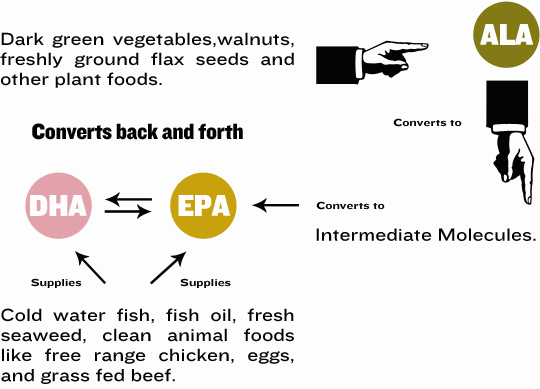
Let me explain a little further. There are 3 types of omega-3’s. There is alpha-linolenic acid (ALA, which are 18 carbon fats), eicosapentaenoic acid (EPA; a 20 carbon fatty acid), and Docosahexaenoic acid (DHA, a 22 carbon fatty acid). ALAs are found in plant foods like walnuts, flaxseeds, and canola oil. EPA and DHA fatty acids are only found in fish and microalgae.

Studies show that ALA omega-3s do not show the same neurological benefits as the DHA omega-3s. When we eat ALA our body has enzymes that can convert ALA to EPA and DHA (by adding additional carbons). While our body is able to convert some ALA to DHA, it is not nearly as much as we need to see the protective neurological benefits. Studies show that about 5% of ALA gets converted to EPA and less than 0.5% of ALA is converted to DHA. On the other hand, when you eat DHA, it is easily converted backwards to EPA and ALA in its necessary amounts.

So someone eats 1 oz of walnuts, that one ounce of walnuts has 2.5g of ALA, of that you'll get 125mg EPA and 12.5mg DHA, and the Academy of Nutrition and Dietetics recommends you get about 500 mg of DHA a day.

When it comes to heart health DHA/EPA still show better protective benefits than ALA. ALA is proven to improve platelet function, inflammation, and cholesterol, but DHA/EPA actually decreases the risk of death from various heart conditions. ALAs are still good for you, so continue to eat your flax meal and walnuts, but as far as brain function and development goes, DHA is what you want. Studies show that DHA omega-3s can change gene expression involved in the brain, prevent oxidative stress, inflammation, and cell death in the brain, and benefit brain growth and development. And like I said before, this is not the case with plant-based ALA omega-3s.

But what about the mercury and PCBs in fish? Okay, valid point, so avoid shark, swordfish, king mackerel, and tilefish because those are high in mercury. You can choose fish low in mercury. The American Heart Association and Academy of Nutrition and Dietetics still recommend that fish is eaten at least twice a week. And as far as I’m concerned, it seems like everything is contaminated with something unless it’s “organic,” and even then, who really knows.

So to sum it up, if you wanna be vegan, that's fine, but I suggest you take a microalge supplement to get your DHAs. The studies so far show that DHAs are the most beneficial omega-3 for heart disease and brain function. I'm all about prevention; if you have crazy running in your family, I think it's about time you start fighting off those bad genes with some DHAs.

Sunday, February 19, 2012

The PoPos


So my family kind of knows me as the oil police.

Example: When I was living with my aunt and uncle in Los Angeles, my aunt was making a salad and I saw olive oil on the counter; in a not very calm voice I asked, “DID YOU PUT OIL IN THERE?!?!?”


My aunt, being the oil sheriff, did not put oil in our salad.

Phew. Everything was okay.


**Background: There are 3 types of fat, saturated, monounsaturated, and polyunsaturated. They get their names from the carbon bonds. All plant oils are going to be a combination of all 3 fats. You want to limit your saturated fat. Your heart healthy fats are you mono and polyunsaturated fats. Your “essential fatty acids” are omega-3s and omega 6’s, which are types of polyunsaturated fats. The typical American diet is high in omega-6s and low in omega-3s**

A lot of people are usually caught off guard when I tell them I don’t use oil.

“But olive oil is sooooo good for you.” Yes, yes it has antioxidants and is a monounsaturated fat. I totally understand that. Other “healthy” oils are avocado, sesame, canola, peanut, and some vegetable oils.

So why don’t I like oil? Well, here’s the deal: 1 tablespoon of oil has about 120 calories. One tablespoon adds up quickly. Maybe you’re using oil in your hummus, as a dip for your bread, to sauté your veggies, to marinade your meat, to fry your egg, to make a salad dressing, or whatever else you may use oil for. By the end of the day, that adds up to a lot of calories! Besides the oil you’re adding to your food, you’re also getting fat from other sources: meats, beans, breads, and yes, even fruits and vegetables. If you’re eating any food that comes in a package, you’re definitely getting fat from that too. Fat is everywhere. You don’t need to get it from oil.

When I eat fat, I chose it wisely. I love nuts; walnuts, pecan, almonds, peanuts, cashews, Brazil nuts, macadamia nuts…I love them all. And I eat some kind of nut almost every day. I also get fat from avocados, olives, and flaxseeds, sunflower seeds, or sesame seeds every once in a while too.

Nuts, seeds, avocados, and olives are not necessarily low calorie foods either. One ounce of nuts is around 200 calories, 2 ounces of avocado is about 100 calories, 10 black olives are 35 calories, 1 oz of sunflower seeds has 165 calories. Something you should also consider

So in a salad, you can have 1 oz of avocado, 2 tablespoons of slivered almonds, with a variety of your veggies, with balsamic vinegar, red wine vinegar, or lemon juice, with some salt and pepper. You’re still getting your calories from fat, but you’re getting them in its whole form; and in my humble opinion, you are enjoying those calories a lot more than you would from oil. I would rather taste my calories in nuts, seeds, olives, or avocado.

But can you get your essential fatty acids without eating oil? Of course you can. It’s recommended that you get 1-2 grams of omega-3’s per day. Seven walnut halves have about 100 calories and 1 gram of omega 3 fatty acids. One tablespoon of ground flaxseeds has about 35 calories and 1.5 grams of omega-3s. Tofu, soy beans, kale, other green leafy veggies, and even berries have some omega-3s!

While oil comes from a natural source, it still goes through processing, removing all the fiber that was once in that whole food. Oil still has great nutrients and antioxidants in it, but not nearly as much as what’s in the whole food. And I must also mention the thermogenic effect of food; this means the energy your body uses to break down and digest food. The energy it takes for your body to break down and digest whole foods and nuts, is higher than the amount of energy it takes to digest oil.

People usually better understand my point when I explain it like this:

We tell people to eat fruit instead of drinking juice. Juice is a concentrated sugar with no fiber. Oil is the same. It’s a concentrated fat with no fiber. Juice and oil are the same in my mind. Neither of them are going to kill you, they both have lots of nutrients, but they certainly aren’t optimal.

If you need to lose weight (and there’s a 2 out of 3 chance you do), I think oil is an easy way to eliminate calories. If you need to gain weight, then adding some healthy oils is an easy way to add calories, but I’d still prefer that you eat the whole nut, seed, olive, or avocado.

Please don’t misunderstand me. I’m not trying to get anyone on a low fat diet. I love fat, but I prefer to get my fats from the whole food, naturally, with all its fiber, vitamins, minerals, and other nutrients.

Tuesday, October 25, 2011

If I Could Be a Wet Nurse...

Twinkle in my eye. Warmth in my heart. Smile on my face. All things that don’t happen when I think about having children.
Giving birth is the least of my worries. Growing another human being in your body and being able to feel it kick and move around is probably the most amazing thing a person can do. People talk about running marathons and biking across the country like it’s really impressive. Please. Grow a human being in your abdomen, THAT’S impressive. However, after birth, things seem to go downhill. There’s crying, teething, pooping, screaming, temper tantrums, down syndrome, autism, Aspergers, car accidents, bullies, broken legs and or arms, cancer, arguing, drinking, drugs, their first break-up, their tenth break up, child molesters, drunk drivers, crazy people in general, etc. Having a child sounds an awful lot like having an 18 year long anxiety attack.
For those of you who have chosen to have children or wish to have children someday, I have one piece of advice for you: breastfeed your child.
I’ve heard it several times; breastfeeding is not easy or fun. It’s inconvenient and can be painful. Well maybe you should have thought about that before you decided to have a child.
Breast feeding your child is good for the baby and good for the mother. It helps prevent babies from developing type 1 and type 2 diabetes, asthma, diarrhea, UTIs, food allergies, dermatistis, leukemia, respiratory infections, gastrointestinal diseases, and obesity related illnesses to name a few. It also enhances an infant’s performance on cognitive development tests and mother-child bonding.
Breast feeding decreases the mother’s risk of developing certain cancers and osteoporosis and helps them get back to their normal weight. When mothers breastfeed, oxytocin is released. This helps prevent mothers from developing postpartum depression.
All of those benefits I just listed… do not come from formula. What’s wrong with formula? The biggest problem with formula is that it is missing the antibodies found in breast milk. The protein in formula is usually from cow’s milk and it takes time for babies’ stomachs to adjust to its’ different biochemical makeup. Formula is not natural and it is expensive!
I understand that some women have a difficult time producing milk, but I also know that when you formula feed your child instead of breastfeed, your body doesn’t produce as much milk because your baby isn’t drinking it. We have smart bodies.
Now don’t get anxiety if you weren’t breast fed as a child, I’m sure you’re just fine. I’m sure your IQ is mediocre and that you have the immune system of an AIDS patient. Kidding. Formula doesn’t kill babies, it’s just not optimal—breast feeding is.

Thursday, August 18, 2011

I Am an Asian Female

Men’s Health. Words cannot describe how I feel about this magazine. I’ll admit, sometimes they get their facts straight when it comes to nutrition. I’m not an avid reader, but I have seen them quote seemingly reliable studies done by Harvard, Loma Linda University, and other respectable research facilities. However, I’ve also read several pieces that I consider to be less than accurate.

I enjoy reading Men’s Health from time to time. I like to read the relationship columns. It’s fun to read what kind of relationship advice men get. Men’s Health is obviously a really appealing magazine for men. It has interesting information on health, exercise, and how to woo the ladies. I suppose the reason Men’s Health bothers me so much is because its’ readers act as if it’s some kind of modern day Bible.

Several males have made statements to me about soy and its’ “feminizing” effects. Where do they get these ridiculous ideas? I think to myself. So I typed in Google, “Men’s Health and soy.” Surprise, surprise. The first hit to come up is an article titled, “Is This the Most Dangerous Food for Men.”

So this article in Men’s Health discussed, what seems to be, every possible study that implies how soy can be damaging to your health. The article mainly focused on a man who drank, on average, 3 quarts (12 cups) of soy milk every day. This man did experience an increase in breast size and elevated estrogen levels. Once he stopped drinking the soy milk, his estrogen levels went back to normal, but his breast size did not. Now, whenever he has even trace amount of soy, his body has a negative reaction.

OMG. This is what’s wrong with society. Men read this and think, if I eat tofu, I will grow moobs (man boobs), my testicles will shrink, I won’t have sex drive, and I will turn into a woman. This is essentially a man’s greatest fear, and it’s only logical, right? Not right. Let’s put our thinking caps on people.

This man was eating, on average, 12 servings of soy a day. ANYONE who eats 12 servings a day of ANYTHING EVERYDAY will have some adverse reaction.

Several studies have shown that soy does not affect sperm count and it is does not lower testosterone levels. Nine published studies have reported that up to 6 cups of soy products a day will not increase men's estrogen levels. Six cups of soy products is a bunch of soy – more than I would EVER recommend for anyone.

Soy is a great source of protein. Like all food, it should be eaten in its least processed form, in correct serving sizes. Edemame, tofu, and soy milk are probably more beneficial soy products, while soy protein supplements, veggie meat, and other highly processed soy goods, are probably not as conducive. Soy has shown to have positive effects on bone health, breast cancer prevention, prostate cancer prevention, blood pressure, cholesterol levels, and pregnancy (don’t worry, this one only pertains to women). Soy is good for you.


So don’t be afraid of soy. It won’t make you less manly, it won’t affect your testosterone levels, and it won’t give you breasts. The Asian population eats more soy than any other nation. I’m pretty sure they don’t have a problem reproducing and when is the last time you saw a large breasted Asian - male or female? I rest my case.

Carolyn: 1; Men's Health: 0 - until we meet again.

Tuesday, August 9, 2011

Level 5 Vegan

“Are you vegan?”
I hate being asked this question. It always has some inference attached to it; Well, you should be vegan, you’re a dietitian. Or, Pssh. Vegans have NO idea what they're missing out on.
I was once asked about my veganism, and I paused, as I always do when I’m asked this question. How do I explain that I’m not vegan, but that I avoid most animal products? My friend quickly jumped in and said, “Carolyn isn’t anything. She basically eats whatever she wants when she feels like it.” I started laughing. It was perfect. This describes me perfectly.
There are so many labels for people and their food choices.
Vegans: No animal products with animal rights beliefs
Total Vegetarians: No animal products, with no extreme ideals towards animal rights; may eat honey
Raw Vegans: No animal products, eat plants, plants can only be cooked to a certain temperature. Not recommended if you want to live.
Vegetarians: Usually means lacto-ovo-vegetarian
Lacto-ovo-vegetarians: Eats animal byproducts: dairy, eggs, honey
Lacto-vegetarians: Does not eat eggs
Ovo-vegetarians: Does not eat dairy
Pescatarian: Eats mostly plants, but eats fish and any seafood
Flexitarian: Almost vegetarian, but eats meat on occasion.
If you fall under one of these categories, that’s great. I don’t. I follow a plant based diet. I eat fruit, vegetables, whole grains, nuts, and beans every day. Some days I eat yogurt, some days I eat eggs, some days I eat fish, some days I eat ice cream, and on the rarest of occasions I’ll eat some chicken. I follow my own dietary guidelines because I know what’s best for me. Yes, I’ll almost always choose the healthier option, but the healthiest choice is not always vegetarian—or vegan.
I will mention that I think that a vegan diet can provide optimal health if planned properly. I will also mention that I think the majority—but not all—vegans are uptight and unreasonable. Following rules, created by mankind, with no leniency, isn’t the lifestyle for me. Today, I was a “total vegetarian.” I had no animal byproducts. Tomorrow, who knows.
This video pretty much sums it up...