Showing posts with label health. Show all posts

Sunday, July 21, 2013

First World Problems

I have paused my career in weight loss counseling and now mainly work in the hospital with pediatric oncology patients. This has allowed me to really reflect on the struggle the majority of Americans have with diet, exercise, and weight loss. This struggle people have, is known as first world problems.
Urban Dictionary defines first world problems as, “Problems from living in a wealthy, industrialized nation that third worlders would probably roll their eyes at.” It also says, “Compared to third world problems our problems don't mean shit.”

People obsess about food. What should I eat? How much should I eat? When should I eat? What time should I stop eating? How many meals a day should I eat? What is the best food I can eat? What supplement do I need? How many grams of sugar should I eat? Then you have the post meal reaction... Oh my goodness, I ate that, I shouldn’t have eaten that. I can’t believe I ate that. Why did I eat that? And the vicious cycle of their first world problem continues... daily...
I have spoken to many people who have experienced this, and my advice to them is...
Stop obsessing. Expending so much time and energy thinking about food only gravitates you towards food... and overeating. There are a million things going on in the world... weight loss and diet is not worth thinking about day in and day out.
Weight loss is not complicated. Eating healthy literally means, eat food, mostly plants, not too much. BAM. There you go. And then the excuses start rolling in.


“No matter what I do, I can’t lose weight.” It get’s old quick, because when it comes down to it, if you followed those simple instructions, you would achieve your goal.

So the obsession with food and it’s nonsensical and unnecessary complexities continues.
Notice the table below, I've talked about it before. The gist of this hierarchy of needs is that you must achieve one level, before fully moving onto the next “level of needs.”

As you can see, food is on the bottom as a physiological need. Next we have safety needs, the need for love and belonging, the need for self esteem and confidence, and finally the need of self actualization. So if your basic physiological needs (for example, food) are not being met, it is incredibly difficult to have the motivation (or time/awareness) to move further on to other needs, such as self esteem or problem solving.
I do not know if you are aware of this, but we are in the top 1% of the world. Our society should be at least on the level of love and belonging if not near the level of self-actualization and trying to solve the world’s problems; not stuck worrying about our basic needs.
Neanderthals were forced to worry about food because it was hard to come by. Today, food will always find you; your only job is to make an educated choice on what food you allow to enter your body. By worrying about such a basic need, you are stunting your growth as a human being and inhibiting your self-actualization, your creativity, and your motivation to succeed in helping yourself and others.
So yes, people struggle with weight loss daily, because they do not choose to eat healthy food or exercise... First world problem.
My friend loves quoting this Proverbs to me, “As a dog returns to his vomit, so a fool repeats his foolishness.” Well, people love basking in their vomit, no matter what their proverbial vomit may be.

Sunday, March 24, 2013

If I was an Atheist


What would change about your life if you were an atheist? It seems that most people’s inclination is to be more wild and promiscuous, which I find funny, but I will save this topic for a later discussion. The biggest thing that would change in my life would be my sense of purpose. If there was no God, I would stop caring about the well-being of humans. Humans have fully functional, reasonable, rational brains that can choose to do whatever they want. Humans determine the outcome of their lives, and continually make bad choices, making themselves and those around them suffer. It’s annoying. If there was no God, there’d be no reason for me to care about these people, so I wouldn't.
If I was an atheist, I’d join PETA and most likely dedicate my life to freeing animals or have the job described in this podcast. I’ve always had a soft spot for animals. Animals are loving and caring beings, yes beings. I’m not about to go through how animals are slaughtered and mistreated, we already know all about that. Go youtube that if you want a reason to feel crappy today.

Anyway, animals are too often underestimated or ignored. Cows, as well as other farm animals have been studied for emotional cues. In these studies, the scientists were able to measure their brainwaves and vitals. Scientists have concluded that cows are capable of feeling fear, anxiety, hold grudges, enjoy sex, and maintain friendships with other cows as well as humans. Some studies even suggest that animals have a sense of self.
Animals also laugh. In a rat study, scientists were able to make rats laugh by tickling them. The rats not only laughed, but also returned to be tickled again, suggesting that humans aren't the only mammals with emotional lives and that animals can also experience social-joy.
Radio lab, my second favorite podcast (my first favorite obviously being LLUC/Randy Roberts), has a fantastic segment on animal minds. In this segment, they discuss the possibility of communication between animals and different species. In this specific episode, they tell a story about a trapped whale who gets rescued, and potentially shows gratitude to her rescuers. This was so touching to me, because my biggest pet peeve is when I allow someone to cut in front of me on the freeway, and they don't show gratitude by giving me the courtesy wave.
If you do choose to eat meat, fine, do whatever you want. My libertarian will always advocate for personal freedom. However, I'd urge you to consider Michael Pollen's take on eating meat. If you're going to eat meat, you need to experience killing an animal and butchering it, so that you can fully understand and appreciate the process. If you had to kill a cow and butcher it every time you wanted to eat one, it seems like you'd do that a lot less often. Killing things is personal, buying lunch meat in the grocery store, is not.

I have no doubt that God exists, meaning I will always find helping humans more important than helping animals. However, animals are still one of God’s creations, and they should be treated with love and kindness.
So the next time you eat meat, I’d like you to consider that you’re eating a being that had a best friend, laughed, enjoyed having sex, and felt fear as it saw it’s family being killed and felt anxiety as it was about to be killed, so that you could eat it. That’s all. enjoy your day.

Saturday, September 8, 2012

Survival Instincts


Survival Instincts
I absolutely hate the term “comfort food.” Whenever I see any type of advertising or labeling that indicates some type of food brings comfort my blood pressure immediately rises and I start silently lashing out at whatever moron decided that was a good idea.
I recently listened to a TED talks on vulnerability. In that short lecture, the speaker said that people use all kinds of things for an escape. Some people use drugs, alcohol, prescription medication, and some people use food. I talk to a lot of people who use food for an escape, a “comfort.”
It makes sense from a scientific standpoint that food brings comfort to people. For the past thousands of years, our ancestors spent a lot of time worrying about food and survival, and when they found food their worry was gone.
Only in the last hundred years, or possibly until after the Depression era, that food became easy and convenient. Essentially since the beginning of time, food relieved humankind from anxiety; and rightfully so.  According to Maslow’s Hierarchy of Needs your physiological needs: food, sleep, sex, etc, are the basis to comfort. It’s only been until recently where access of food has not been an issue for survival.
Mankind is use to the biggest “threat” (survival) being resolved by food. Now that we’ve pretty much established our physiological needs, our biggest "threats" are the next few levels on Maslow’s triangle: Safety: security of the family, health, property, etc; Love/Belonging: friendship, family, sexual intimacy; and Esteem: self-esteem, confidence, respect, and achievement.
Our ancestors were stressed/felt threatened, ate food, and were not stressed or threatened anymore because their survival was no longer at risk. Today, we’re stressed about making ends meet, being loved, our families health, intimate relationships, being successful, or whatever, but instead of making choices to take care of the actual issue, people are still looking to food to clear their anxiety.
Some may argue this is due to behavioral genetics. Some scientists believe that our genes determine more than just eye or hair color; that more abstract traits such as intelligence, personality, aggression, and sexual orientation are also encoded in our DNA—so interesting to read about btw.
It could also be argued that these bad eating habits are actually learned behaviors from parents or caregivers, and most likely, it's a combination. 
Anyway, despite whatever genetics or learned behaviors passed down generation to generation indicating food will give us comfort, everyone still has a brain to figure out what will solve the problems you have (big or small) and ACTUALLY provide comfort and happiness--and it's not food. 
I’m a firm believer that nurture can overcome any nature:) We were all given some type of genetic lemons in life, you can make lemonade because that’s what feels right, or you can be smart and make salad dressing <3 span="span">

Monday, August 13, 2012

25 and Going on Menopause


In this past season of the Bachelorette, Emily asks one of her dates, Ryan, if he would still love her in 10 years if she got fat. Ryan famously answers, “I’d love ya, but I wouldn’t love on ya.” I never liked Ryan, but appreciated his honesty. My friend was not offended by Ryan’s comment, “Imagine you marry someone who has a good job and works hard, and once you get married, he quits his job, sits on the couch all day, and collects unemployment. Would you feel lied to?”

“I would be able to sense his poor work ethic and I wouldn't be attracted to him in the first place, so that would never happen to me, but I guess I understand your analogy,” I told him.

I work with a lot of women who struggle with weight gain, and a lot of these women attribute it to age and a slowing metabolism. I’ve heard variations of this story several times, “I weighed 120 lbs when I got married, and now I weigh 180.”

This use to make me worried, because I almost felt as if weight gain was inevitable, but the more I talk to women, the more I realize, it is not inevitable. While counseling these women on developing healthy lifestyles, I continuously make mental notes of where I think they’ve gone wrong. I’ve compiled a list:

1. Develop good eating habits now. When I was in high school I worked at Cold Stone and ate ice cream every day, I would go to In-n-Out and get a grilled cheese sandwich with extra sauce and French fries, and I never exercised; I was 95 lbs. I could still do this now if I didn’t mind looking like Jabba the Hut and having a heart attack at 45. If you eat poorly, you will get fat… it’s all about portion sizes and healthy choices, everyday.

2. Don't stop exercising. Use it or lose it. Muscle tone and regular cardio will keep your metabolism going. Everyone’s excuse is that there is “no time.” Make time. Time management is a struggle for everyone, but it’s doable. The longer you're sedentary, the harder it is to start exercising again... But it's never too late to start :)

3. Don’t wear pants with elastic. I’m serious. Have you been in a hospital lately? I am convinced that if hospital workers had to wear jeans to work, their weight would drop by at least 10%. If your job requires you to wear scrubs, when you go home, put on a pair of jeans. It’s really easy to gain weight when you wear one size fits all clothes 24/7. This includes leggings. It’s a slippery slope. Be careful. Wearing dresses everyday is pretty risky too.

4. Make time to relax. Chronic stress is the new plague. Find anything enjoyable that allows you to figure out your s appropriately. Talk it out, hug it out, write it out, or whatever it takes to manage whatever problems you have.

5. Have hobbies; hobbies that don’t involve food. Everyone should do something that makes them unique, happy, and accomplished. Being a mom is great, but it doesn’t count as a hobby.

6. Learn good coping mechanisms. People are taught a lot of things, coping mechanisms aren’t one of them. I see a lot of people who eat because they’re depressed, stressed, or anxious. If you don’t know what good coping mechanisms are, buy a book on coping skills.

7. Get some positive thinking skills—hormonal changes never results in rational thinking. Don’t let yourself get depressed. Happiness is a choice. Laugh and smile. No one likes a scowl, and there are always things to laugh about. Life is great.


So I’m turning 25 this year and I have nothing to worry about :)

Tuesday, April 10, 2012

Things Change.

I’ve never understood why people are so disgusted by meat. I’ve been on several dates where the guy has asked my permission to order meat. I appreciate their thoughtfulness, but I also think it’s such a silly question. Why would I care if they ate meat?

My siblings and I were the only vegetarians in our entire extended family, so I’ve grown up around meat and meat eaters. I have always thought that people who think meat is “gross” are closed-minded and sheltered. My point is that I don't care, and never have cared, if people choose to eat meat.

About a year ago I started eating fish. I started eating fish because I loved the flavor. My roommate/classmate/friend told me, “Fish is a gateway meat; it’s only a matter of time before you start eating chicken..turkey… then who knows.” I laughed and thought it was probably true, and it was.

Within the past month, I started lifting weights, and I wanted to increase my protein intake, so I calculated that each of my meals should be at about 20 grams of protein. I eat at the hospital a lot and they serve chicken a lot, so I started having chicken at lunch. I’d rather eat chicken than drink a protein shake, I told myself. Who knows what’s in a protein shake? Where are they getting the protein? It’s so processed. Protein shakes are not natural and we were not meant to eat protein like that.

So there I am at the hospital… Hmmm… what to eat, they aren’t serving anything good today. I’ll just have this chicken pesto wrap. That sounds good, 380 calories and 26 grams of protein. As I’m eating my sandwich these are my following thoughts:

Hm. This is not a whole wheat wrap, that’s unfortunate; I wish this was a whole wheat wrap…

This lettuce is a little wilted… I wonder how long this sandwich was made…

Sheesh this is a lot of chicken… I tell my patients to eat 3 oz of meat per meal or the size of the palm of their hand… this chicken is like 2 palms of my hand. Eh, just finish the sandwich you need the protein to build muscle….

I’ve never eaten this much chicken in my entire life. I don’t want to eat this anymore…

Why did I eat this? How does meat get digested? When you eat whole grains, vegetables, fruits, nuts, and beans the fiber helps the food get digested and moves it through your body… What is moving this chicken through my body? Nothing. NOTHING is moving this chicken through my body. This wasn’t even a whole wheat wrap! And that lettuce hand like 1 gram of fiber! How will this chicken ever get out of my body!? I HAVE A ROTTING CHICKEN CARCASS STUCK IN MY BODY.

Since this incident, I have not touched meat. And the thought of eating meat is nauseating. Right now, when I was talking about “liking fish,” it made me shutter with disgust. Because now when I think of eating meat, all I can think about is having a dead animal in my body. I don’t want any dead animals in my body.

I’ve always said that being vegan is most likely the most optimal diet. I’m not vegan. I eat cheese and Greek yogurt. I think the most important thing is having plant based diet. Meaning you eat mostly plants: brown rice, barley, beans, lentils, fruits, vegetables, split peas, almonds, walnuts, and other nuts. If some dairy or eggs get in there, fine, a little dairy and eggs won’t kill you (although some will argue that point). If you want to add some meat in there, that’s fine too. Just make sure it’s organic or from a trusted farm and eat high fiber foods with it. No one likes a rotting carcass in their intestines.

Maybe my thought process is irrational, but at this time, I can’t get that picture of meat carcass out of my head. Being a vegetarian has so many health benefits, decrease in cancer, decrease in heart disease, and overall longevity. Being vegetarian also has a lot of non-health related benefits: better for the environment, less production of meat, and less animal cruelty – yes that really does happen.

Here’s an article my friend posted on chicken and what they do to it… and if they’re doing it to chicken, you know they’re doing it to other animals too.

http://www.nytimes.com/2012/04/05/opinion/kristof-arsenic-in-our-chicken.html?_r=1&src=tp&smid=fb-share

Monday, February 27, 2012

Bucket List

I am not known for my love of the outdoors. I appreciate nature and the comfort of the indoors. However, I will never forget my first time in Bass Pro Shop. I was just hanging out with my dad one afternoon and he suggested we go there. That store is like an amusement park for mountain men. I was impressed. I was probably equally excited about that store as I would be in Nordstrom during their anniversary sale. Weird, I know, but there are so many cool gadgets and little useful tools. Who knew so much thought went into outdoor activities. It made me feel like I could survive a week long camping trip, in a tent. Anyway, this store became particularly useful to me when I realized something on my bucket list was to physically catch, gut, scale, cook, and eat a fish. After reading the Omnivore’s Dilemma, I realized that if you choose to eat meat, you should experience what it really means to eat meat. Meat is not just food. It is an animal that was once alive, living, just chilling, until it was killed, so that you could eat it.

The key concept here is that YOU didn’t have to kill it. You just BOUGHT it in a grocery store; lifeless, guilt-free, packaged, ready for you to cook up and eat. It’s not the same as buying a loaf of bread or a bag of chips. In reality, if you had to kill that animal yourself, you’d probably think twice about eating a steak. I mean, would you want to slit a cow’s throat and butcher it?! I’m not trying to get all animal rights on you, but killing animals is kind of a big deal when you have to do it yourself.

Anyway, I’ve chosen to eat fish. So I think it’s only right that I experience killing my own fish at some point in my life.

To be honest, I started eating fish before I knew about any of its health benefits. I genuinely love the flavor of fish. If you don’t like fish, that’s fine, but you should keep reading because there’s still valuable information in here for you.

Fish is good for you. It is inarguably better for you than red meat, pork, shell fish, crustaceans, chicken, turkey, or any other meat. The American Heart Association recommends that you eat fish two times a week. It doesn’t make that recommendation for any other animal product.

The obvious benefits of fish, like tuna salmon, herring, halibut, and bass, are the healthy omega-3 fatty acids. The omega-3 fats have shown to dramatically decrease your risk for heart disease and heart attacks. They’re also beneficial for reducing your risk for stroke, inflammation, triglycerides, and even increases insulin sensitivity.

So there’s no argument that omega-3’s are good for you. Omega-3s help the heart. Everyone knows it. It's cool, but that was so 30 seconds ago. What interests me about omega-3s are their positive influence on brain function. EPA and DHA (two long chain omega-3 fatty acids) produce substances that protect our brain and its cells. Several studies have showed that EPA and DHA may benefit those with ADHD, autism, dyslexia, depression, bipolar disorder, and dementia, and promote optimal brain development in babies. This is a big deal. The food we eat can influence the functionality of our brain. When our body breaks down and metabolizes DHAs, the metabolites or byproducts, function to enhance cognitive performance.

My class-five vegan friends would like to argue that you don’t need to eat fish to get your omega-3’s; they would say you can get your omega-3’s from seaweed, walnuts, flaxseeds, and other plant sources, and they are correct. “Fish get their omega-3’s from seaweed,” a vegan may argue. Well yes Vegan, that’s true, but do you know how much seaweed you would have to eat to get as much omega-3s as fish? More than I’m willing to eat in a day.

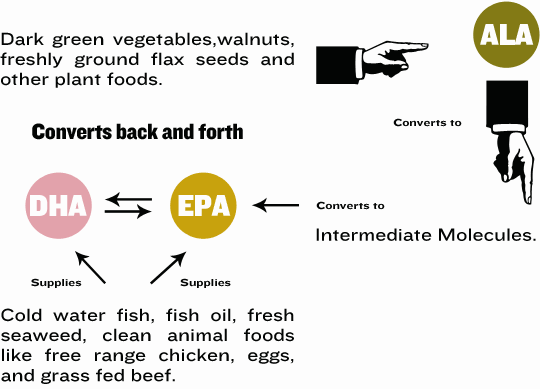
Let me explain a little further. There are 3 types of omega-3’s. There is alpha-linolenic acid (ALA, which are 18 carbon fats), eicosapentaenoic acid (EPA; a 20 carbon fatty acid), and Docosahexaenoic acid (DHA, a 22 carbon fatty acid). ALAs are found in plant foods like walnuts, flaxseeds, and canola oil. EPA and DHA fatty acids are only found in fish and microalgae.

Studies show that ALA omega-3s do not show the same neurological benefits as the DHA omega-3s. When we eat ALA our body has enzymes that can convert ALA to EPA and DHA (by adding additional carbons). While our body is able to convert some ALA to DHA, it is not nearly as much as we need to see the protective neurological benefits. Studies show that about 5% of ALA gets converted to EPA and less than 0.5% of ALA is converted to DHA. On the other hand, when you eat DHA, it is easily converted backwards to EPA and ALA in its necessary amounts.

So someone eats 1 oz of walnuts, that one ounce of walnuts has 2.5g of ALA, of that you'll get 125mg EPA and 12.5mg DHA, and the Academy of Nutrition and Dietetics recommends you get about 500 mg of DHA a day.

When it comes to heart health DHA/EPA still show better protective benefits than ALA. ALA is proven to improve platelet function, inflammation, and cholesterol, but DHA/EPA actually decreases the risk of death from various heart conditions. ALAs are still good for you, so continue to eat your flax meal and walnuts, but as far as brain function and development goes, DHA is what you want. Studies show that DHA omega-3s can change gene expression involved in the brain, prevent oxidative stress, inflammation, and cell death in the brain, and benefit brain growth and development. And like I said before, this is not the case with plant-based ALA omega-3s.

But what about the mercury and PCBs in fish? Okay, valid point, so avoid shark, swordfish, king mackerel, and tilefish because those are high in mercury. You can choose fish low in mercury. The American Heart Association and Academy of Nutrition and Dietetics still recommend that fish is eaten at least twice a week. And as far as I’m concerned, it seems like everything is contaminated with something unless it’s “organic,” and even then, who really knows.

So to sum it up, if you wanna be vegan, that's fine, but I suggest you take a microalge supplement to get your DHAs. The studies so far show that DHAs are the most beneficial omega-3 for heart disease and brain function. I'm all about prevention; if you have crazy running in your family, I think it's about time you start fighting off those bad genes with some DHAs.

Sunday, February 19, 2012

The PoPos


So my family kind of knows me as the oil police.

Example: When I was living with my aunt and uncle in Los Angeles, my aunt was making a salad and I saw olive oil on the counter; in a not very calm voice I asked, “DID YOU PUT OIL IN THERE?!?!?”


My aunt, being the oil sheriff, did not put oil in our salad.

Phew. Everything was okay.


**Background: There are 3 types of fat, saturated, monounsaturated, and polyunsaturated. They get their names from the carbon bonds. All plant oils are going to be a combination of all 3 fats. You want to limit your saturated fat. Your heart healthy fats are you mono and polyunsaturated fats. Your “essential fatty acids” are omega-3s and omega 6’s, which are types of polyunsaturated fats. The typical American diet is high in omega-6s and low in omega-3s**

A lot of people are usually caught off guard when I tell them I don’t use oil.

“But olive oil is sooooo good for you.” Yes, yes it has antioxidants and is a monounsaturated fat. I totally understand that. Other “healthy” oils are avocado, sesame, canola, peanut, and some vegetable oils.

So why don’t I like oil? Well, here’s the deal: 1 tablespoon of oil has about 120 calories. One tablespoon adds up quickly. Maybe you’re using oil in your hummus, as a dip for your bread, to sauté your veggies, to marinade your meat, to fry your egg, to make a salad dressing, or whatever else you may use oil for. By the end of the day, that adds up to a lot of calories! Besides the oil you’re adding to your food, you’re also getting fat from other sources: meats, beans, breads, and yes, even fruits and vegetables. If you’re eating any food that comes in a package, you’re definitely getting fat from that too. Fat is everywhere. You don’t need to get it from oil.

When I eat fat, I chose it wisely. I love nuts; walnuts, pecan, almonds, peanuts, cashews, Brazil nuts, macadamia nuts…I love them all. And I eat some kind of nut almost every day. I also get fat from avocados, olives, and flaxseeds, sunflower seeds, or sesame seeds every once in a while too.

Nuts, seeds, avocados, and olives are not necessarily low calorie foods either. One ounce of nuts is around 200 calories, 2 ounces of avocado is about 100 calories, 10 black olives are 35 calories, 1 oz of sunflower seeds has 165 calories. Something you should also consider

So in a salad, you can have 1 oz of avocado, 2 tablespoons of slivered almonds, with a variety of your veggies, with balsamic vinegar, red wine vinegar, or lemon juice, with some salt and pepper. You’re still getting your calories from fat, but you’re getting them in its whole form; and in my humble opinion, you are enjoying those calories a lot more than you would from oil. I would rather taste my calories in nuts, seeds, olives, or avocado.

But can you get your essential fatty acids without eating oil? Of course you can. It’s recommended that you get 1-2 grams of omega-3’s per day. Seven walnut halves have about 100 calories and 1 gram of omega 3 fatty acids. One tablespoon of ground flaxseeds has about 35 calories and 1.5 grams of omega-3s. Tofu, soy beans, kale, other green leafy veggies, and even berries have some omega-3s!

While oil comes from a natural source, it still goes through processing, removing all the fiber that was once in that whole food. Oil still has great nutrients and antioxidants in it, but not nearly as much as what’s in the whole food. And I must also mention the thermogenic effect of food; this means the energy your body uses to break down and digest food. The energy it takes for your body to break down and digest whole foods and nuts, is higher than the amount of energy it takes to digest oil.

People usually better understand my point when I explain it like this:

We tell people to eat fruit instead of drinking juice. Juice is a concentrated sugar with no fiber. Oil is the same. It’s a concentrated fat with no fiber. Juice and oil are the same in my mind. Neither of them are going to kill you, they both have lots of nutrients, but they certainly aren’t optimal.

If you need to lose weight (and there’s a 2 out of 3 chance you do), I think oil is an easy way to eliminate calories. If you need to gain weight, then adding some healthy oils is an easy way to add calories, but I’d still prefer that you eat the whole nut, seed, olive, or avocado.

Please don’t misunderstand me. I’m not trying to get anyone on a low fat diet. I love fat, but I prefer to get my fats from the whole food, naturally, with all its fiber, vitamins, minerals, and other nutrients.

Tuesday, October 25, 2011

If I Could Be a Wet Nurse...

Twinkle in my eye. Warmth in my heart. Smile on my face. All things that don’t happen when I think about having children.
Giving birth is the least of my worries. Growing another human being in your body and being able to feel it kick and move around is probably the most amazing thing a person can do. People talk about running marathons and biking across the country like it’s really impressive. Please. Grow a human being in your abdomen, THAT’S impressive. However, after birth, things seem to go downhill. There’s crying, teething, pooping, screaming, temper tantrums, down syndrome, autism, Aspergers, car accidents, bullies, broken legs and or arms, cancer, arguing, drinking, drugs, their first break-up, their tenth break up, child molesters, drunk drivers, crazy people in general, etc. Having a child sounds an awful lot like having an 18 year long anxiety attack.
For those of you who have chosen to have children or wish to have children someday, I have one piece of advice for you: breastfeed your child.
I’ve heard it several times; breastfeeding is not easy or fun. It’s inconvenient and can be painful. Well maybe you should have thought about that before you decided to have a child.
Breast feeding your child is good for the baby and good for the mother. It helps prevent babies from developing type 1 and type 2 diabetes, asthma, diarrhea, UTIs, food allergies, dermatistis, leukemia, respiratory infections, gastrointestinal diseases, and obesity related illnesses to name a few. It also enhances an infant’s performance on cognitive development tests and mother-child bonding.
Breast feeding decreases the mother’s risk of developing certain cancers and osteoporosis and helps them get back to their normal weight. When mothers breastfeed, oxytocin is released. This helps prevent mothers from developing postpartum depression.
All of those benefits I just listed… do not come from formula. What’s wrong with formula? The biggest problem with formula is that it is missing the antibodies found in breast milk. The protein in formula is usually from cow’s milk and it takes time for babies’ stomachs to adjust to its’ different biochemical makeup. Formula is not natural and it is expensive!
I understand that some women have a difficult time producing milk, but I also know that when you formula feed your child instead of breastfeed, your body doesn’t produce as much milk because your baby isn’t drinking it. We have smart bodies.
Now don’t get anxiety if you weren’t breast fed as a child, I’m sure you’re just fine. I’m sure your IQ is mediocre and that you have the immune system of an AIDS patient. Kidding. Formula doesn’t kill babies, it’s just not optimal—breast feeding is.

Tuesday, August 9, 2011

Level 5 Vegan

“Are you vegan?”
I hate being asked this question. It always has some inference attached to it; Well, you should be vegan, you’re a dietitian. Or, Pssh. Vegans have NO idea what they're missing out on.
I was once asked about my veganism, and I paused, as I always do when I’m asked this question. How do I explain that I’m not vegan, but that I avoid most animal products? My friend quickly jumped in and said, “Carolyn isn’t anything. She basically eats whatever she wants when she feels like it.” I started laughing. It was perfect. This describes me perfectly.
There are so many labels for people and their food choices.
Vegans: No animal products with animal rights beliefs
Total Vegetarians: No animal products, with no extreme ideals towards animal rights; may eat honey
Raw Vegans: No animal products, eat plants, plants can only be cooked to a certain temperature. Not recommended if you want to live.
Vegetarians: Usually means lacto-ovo-vegetarian
Lacto-ovo-vegetarians: Eats animal byproducts: dairy, eggs, honey
Lacto-vegetarians: Does not eat eggs
Ovo-vegetarians: Does not eat dairy
Pescatarian: Eats mostly plants, but eats fish and any seafood
Flexitarian: Almost vegetarian, but eats meat on occasion.
If you fall under one of these categories, that’s great. I don’t. I follow a plant based diet. I eat fruit, vegetables, whole grains, nuts, and beans every day. Some days I eat yogurt, some days I eat eggs, some days I eat fish, some days I eat ice cream, and on the rarest of occasions I’ll eat some chicken. I follow my own dietary guidelines because I know what’s best for me. Yes, I’ll almost always choose the healthier option, but the healthiest choice is not always vegetarian—or vegan.
I will mention that I think that a vegan diet can provide optimal health if planned properly. I will also mention that I think the majority—but not all—vegans are uptight and unreasonable. Following rules, created by mankind, with no leniency, isn’t the lifestyle for me. Today, I was a “total vegetarian.” I had no animal byproducts. Tomorrow, who knows.
This video pretty much sums it up...

Friday, May 6, 2011

I was wrong.

As you can tell by now, the ideas, thoughts, and opinions of others when it comes to nutrition are not well received by me. Just because you read something in a magazine, doesn’t make you a nutrition expert. I really can’t emphasize this enough.
When I’d hear or read anything regarding chocolate and its seemingly-equivocal health claims, I’d think, Psh. Yeah right. Eat chocolate to be healthy. YEAH RIGHT. THIS is why America is obese, because people think that things like chocolate are the solution.
Well, it turned out, for the first time ever, I misjudged the situation.
I was assigned to give a presentation about chocolate in relation to cardiovascular disease. It wasn’t my top choice, but I would have been happy with any of the topics. You can’t go wrong in a class called, Phytochemicals.
There are several different types of chocolate and I’ve broken them down for you in the following table:
Type:
About
Cacao
A seed (high in fat) from the cocoa tree fruit
Cocoa Liquor
A paste made from ground, roasted, shelled and fermented cocoa beans (% cacao on food packaging)
Cocoa Powder
The cocoa liquor with cocoa butter removed, making a powder
Dark Chocolate
A solid food made by combining cocoa liquor with cocoa butter and sugar; amount of liquor determines darkness of chocolate
Milk Chocolate
The addition of condensed or powdered milk to the chocolate mixture
Semi-sweet Chocolate
Referred to as ‘dark’ chocolate, but is only dark if it contains 35% chocolate liquor by weight
White Chocolate
Contains only cocoa butter (at least 20% by weight) combined with sweeteners and dairy ingredients
The polyphenols found in chocolate are what makes it healthy. Polyphenols are found in the cocoa liquor. The more cocoa liquor, or the ‘darker’ the chocolate, the better it is for you. Dark chocolate also has less sugar than the other chocolate varieties. Milk chocolate contains a fraction of the polyphenols, so it is not nearly as good for you. White chocolate has always been my favorite type of chocolate; it has NO health benefits.
Dark chocolate has been shown to lower blood pressure, lower your LDL-cholesterol, raise your HDL-cholesterol, decrease biomarkers for inflammation, decrease your risk for plaque build-up, and fight against free radicals.
That is a very simplified summary of what chocolate does to your body. My conclusion after completing my research is that chocolate really is a health food.
Before you go out and start binging on chocolate, there are a few disclaimers:
· Chocolate is high in saturated fat
· Chocolate is high in calories
· The more benefits are seen in the darkest chocolates
As far as the saturated fat goes, the saturated fat in chocolate is structurally similar to the fat found in olive oil, so it is not as damaging as other saturated fats.
If you eat ANYTHING in the wrong amount, it’s going to lead to weight gain. Chocolate should still be eaten in the portion of a dessert, not a vegetable.
If you’re going to eat chocolate, I recommend eating the darkest chocolate you can tolerate. I would choose a dark chocolate that is sweetened with dried fruit pieces. The dried fruit will have different polyphenols than the chocolate and will likely have a synergistic effect on protecting your body from free radicals and developing heart disease.
And remember, nothing gives you optimal health like a healthy diet AND exercise J

Saturday, February 5, 2011

If you want to impress me

I have been jaw-dropping impressed by a man’s body once in my life. I remember it well. I was living in Tennessee and a bunch of girls went to see The Prestige…and in this one scene, Hugh Jackman literally took my breath away. I’m not saying I’m hard to impress, it’s just incredibly unusual for muscles to impress me. I have a friend who really appreciates muscular men. From time to time she’ll point out guys she finds really attractive. I just smile and think to myself… that guy is obviously a self-absorbed a-hole. I know it’s a hasty generalization, but seriously, men who have HUGE muscles are usually too busy looking at themselves in the mirror to even realize that there are other things going on in the world.
These super macho muscular men are usually obsessed with protein supplements. I don’t like protein supplements for two reasons. First, I like keeping things natural. Secondly, I cannot imagine that taking protein supplements long term can be good for your health, not to mention it’s likely to be indicative of certain personality traits. Let me elaborate.
First of all, let’s begin with how much protein you need in a day. The average healthy person needs 0.8g of protein/kg. SO… if a man weighs 150 lbs and is not a body builder, he needs about 55 grams of protein a day. This is easily obtainable through diet (even a vegetarian diet!). Anyway, when you begin weight lifting, your protein needs go up to anywhere from 1.0-1.7 g PRO/kg; that 150 lbs man would need 68g-116g of protein if he started weight lifting.
So now you’re thinking, see! You need more protein! Well hold on to your britches, I’m not done yet. If you were to eat this in a day:
· Breakfast: 1 med sized apple, 1.5 cups cheerios, 1.5 cup non-fat milk
· Lunch: Turkey Sandwich (2 slices of turkey, 2 slices of whole wheat bread) 15 baby carrots
· Dinner: 1 med baked potato, 1.5 cups chili beans
That gives you only 1615 calories and a whopping 71g of protein! And seriously, if you’re a male, you know you eat more than 1600 calories, meaning you’re probably getting more than 71g of protein a day, meaning you probably don’t need to be taking protein supplements to build those great big manly muscles.
So what’s wrong with taking protein supplements? Well, as far as the studies show, nothing is wrong with taking the recommended doses. However, I think supplements of any kind should be taken sparingly. Virtually the only supplements I promote are vitamin D and omega-3s. Calcium supplements are important for those prone to osteoporosis. As far as multivitamins go, go ahead and take one, but is it necessary? Not if you have a balanced diet.
Protein is so easily obtained in your diet that there is absolutely no reason to go out of your way to supplement it. I also think the source of protein should be taken into consideration. Getting your protein from plant based sources will provide you with lots of vitamins, minerals, antioxidants, phytochemicals, and fiber! Getting your protein from supplements is going to give you a whole bunch of rubbish that you can’t even pronounce (read the ingredients).
As I said, there are no long term scientific studies stating that protein supplements are in any way detrimental to your health when taken in the correct dosage. But when we eat excess amounts of protein, our body produces more urea, which must be filtered through the kidneys. Now this is purely my speculation, but when you overuse ANYTHING for an extended period of time, it’s more than likely going to get worn out faster. Overloading your body with excess protein, vitamins, and minerals may stress your kidneys or overwork them, especially if practiced over a number of years. If you insist on supplementing, you should at least try to drink plenty of water to help filter everything out.
People supplement protein so that they can have “better athletic performance.” Why can’t you get that protein from regular food? The average protein supplement gives you about 25g of protein, which hopefully by now you realize isn’t necessary when you’re eating three meals a day. However, having a high protein snack after lifting has shown to enhance training results. If you want a high protein snack after weight lifting try one of the following
  • Low fat cottage cheese and fruit
  • Low fat yogurt
  • Hummus and carrots
  • Peanut butter and celery (be careful with peanut butter, it’s really high in calories
  • Peanut butter on a slice of whole wheat toast
  • A simple glass of milk (soy is preferable)
  • 1 oz of mixed nuts
Other high protein foods include
  • Lentils and rice
  • Beans and a whole wheat tortilla
  • Oatmeal
  • Tofu and vegetables
  • Chili and cornbread
Earlier I said that protein supplements are indicative of certain personality traits. When someone tells me they’re taking protein supplements, I often too quickly write them off as “one of those.” One of those who feels their body is inadequate so they have to take protein supplements to have a “nice” body. I know I’m stereotyping, but jocks get stereotyped for a reason. In fact, I find muscles to be a huge red flag. Muscular guys are often stereotyped as being mean or dumb, and if I have to choose between intelligence and muscles, intelligence is going to win every time. It’s like; oh you can bench press 200 lbs?! Awesome, what
an accomplishment, but do you know the rate limiting steps in glycolysis or who you’re going to vote for in the next presidential elections? Because that is something actually worth talking about. It’s cool that you can do a one-handed push-up, but can you do anything else?
So what’s the take home message? Protein supplements really aren’t necessary, and they might hurt you if used consistently over a number of years. Get your protein from good sources likes beans, nuts, whole grains, and vegetables. You can easily get enough protein from your diet. If you’re still convinced that you need supplements, at least drink a lot of water. And please understand that I’m not hating on exercise. Exercising is really important for your health. Strength training will help improve your muscle mass which will help you when you’re old and brittle. I’m just saying exercising your brain is equally important.